
Importing a car from Japan to the UK: rules, costs and what to check before it ships
Sources checked 2 October 2026
Most used cars from Japan can be registered in Great Britain. If the car is more than 10 years old, it doesn't need vehicle approval. You'll pay customs duty (10%, or 0% if the car qualifies as Japanese-originating under the UK–Japan trade agreement) and 20% VAT, tell HMRC within 14 days, get an MOT if it's over 3 years old, and register it with the DVLA for £55.
The paperwork is the predictable part. What goes wrong is the car itself. Once it's on a ship, any fault is yours to deal with in the UK, and the MOT pays particular attention to corrosion around the suspension, brake and steering mountings, and dealers' photos rarely show those. Photos show less than you think.
This page covers Great Britain (England, Scotland and Wales). Northern Ireland differs in places, such as the age at which a car needs an MOT.
Which cars can come in
- Right-hand drive is normal. Japan drives on the left, like the UK, so Japanese-market cars are already right-hand drive.
- Over 10 years old: no vehicle approval. Cars with 8 passenger seats or fewer that were first registered or made more than 10 years ago are exempt from vehicle approval. This covers most of the older Japanese cars people import.
- Under 10 years old: you need approval. A car that isn't registered in the EU needs Individual Vehicle Approval (IVA). Personal imports can use basic IVA, which is a visual inspection and tests at a DVSA test centre. DVSA usually offers an inspection within 20 working days, and there's a fee.
- Over 3 years old: you need an MOT before the DVLA will register it.
- "Seriously damaged" cars can't be registered. That means a car that can't be repaired, such as a statutory write-off. The DVLA won't refund duty, VAT or approval fees you've already paid on one.
- Structurally modified cars need extra paperwork. If the car has been modified beyond the maker's specification (for example cut or welded body structure), you send form V627/3 with the registration.
What it costs
| Item | How much | Notes |
|---|---|---|
| Customs duty | 10% | 0% may apply under the UK–Japan agreement, but only if the car counts as Japanese-originating and your customs agent can support the claim. Rates shown are for a used petrol car of 1,500–3,000cc; check the code for your car |
| Import VAT | 20% | Charged on the car plus delivery, extra charges and the duty |
| DVLA registration | £55 | Plus the first vehicle tax, paid when you register |
| MOT | Test fee | Needed if the car is over 3 years old |
| IVA | DVSA fee | Only if the car is under 10 years old |
| Shipping, customs agent, NOVA | Quoted by the company | A shipping company or customs agent has to make the import declaration for you |
| Insurance | Your insurer | Before you drive it on UK roads |
A rough example. For every ¥1,000,000 of car and shipping (about £4,780 on 1 October 2026), duty and VAT at the full rate add about ¥320,000 (about £1,530): 10% duty, then 20% VAT on the total including the duty. If the 0% Japan rate applies, it's about ¥200,000 (about £960). These are estimates at the European Central Bank's reference rate of 1 October 2026 (£1 = about ¥209). Your agent works out the real figure.
Cars over 30 years old. HMRC has a reduced valuation for some collectors' vehicles that are at least 30 years old and in their original state, which brings import VAT down to an effective 5%. The conditions are narrow (scarcity, high value, historical interest, and more), so ask your agent before you count on it.
The steps, in order
If a company ships the car for you:
- Before you pay for the car: know what you're buying (see below), and ask your shipper or customs agent which duty rate they'll claim and what they need from you.
- Import declaration. Your shipping company or customs agent makes it, before arrival or at the UK border, and usually pays the VAT and duty for you.
- Tell HMRC within 14 days (NOVA). Your agent can do this for a fee, or HMRC's CARS team can do it for you. It needs the customs documents (C88 and E2, or the MRN), the invoice or bill of sale if you bought the car in the last 6 months, and an official document showing the chassis number, such as the export certificate. If you bought the car more than 6 months ago, you need a valuation done in person in the UK.
- MOT or IVA. You can't use the car on the road until these steps are done, except to drive to a pre-booked MOT or approval test.
- Register and tax with the DVLA. Send form V55/5 with the £55 fee, the vehicle tax, proof of approval if the car needs it, MOT evidence if it's over 3 years old, and the original foreign registration document. For a car leaving Japan this is usually the export certificate, issued when the Japanese registration is cancelled for export. The DVLA keeps it. The registration certificate (V5C) can take up to 6 weeks to arrive.
- Number plates and insurance. You need the V5C to get plates made up.
Where Japanese imports get stuck
Rust near the suspension, brake and steering mountings. The MOT treats the structure within 30cm of where the brakes, steering and suspension are mounted as "prescribed areas". Corrosion there fails the test if it has made a hole, or if the metal doesn't feel firm under finger and thumb. The manual doesn't list parts by name. It works by distance from each mounting. A front strut is mounted to the body at the strut top, so that's one of the places we'd ask a seller to photograph, along with the sills and the floor.
Our founder, who works in paintless dent repair and detailing, puts the underside and the strut tops well ahead of the outside panels on a used car from Japan. More on that in what dealer photos miss.
A missing rear fog lamp. Cars first used on or after 1 April 1980 need one red rear fog lamp, fitted in the centre or on the right-hand (offside) side, and the MOT checks it. Look at the rear lights on the car you're buying, and plan to fit one if it isn't there.
Paperwork that doesn't arrive. The DVLA wants the original export certificate, not a copy. Make sure it travels with the car or reaches you through your shipper.
Damage you find out about later. A car the DVLA treats as seriously damaged can't be registered, and the money already spent on duty, VAT and approval isn't refunded.
What this page can't tell you
- Whether a particular car will pass its MOT or IVA. Only the test does that. We don't lift cars, so we can't see the whole underside.
- Your exact duty rate. It depends on the car's tariff code and whether it qualifies for the Japan rate. Your customs agent or HMRC confirms it.
- Legal or customs advice. This is a plain summary of the official guidance, checked on the date below. Rules and fees change, so read the source pages before you commit.
Before the car ships is the point where a problem is cheapest to deal with. Send us the listing and tell us where you're worried: the strut tops, the sills, the rear lights. We can go and look, and photograph what can be seen from ground level. See how a viewing works.
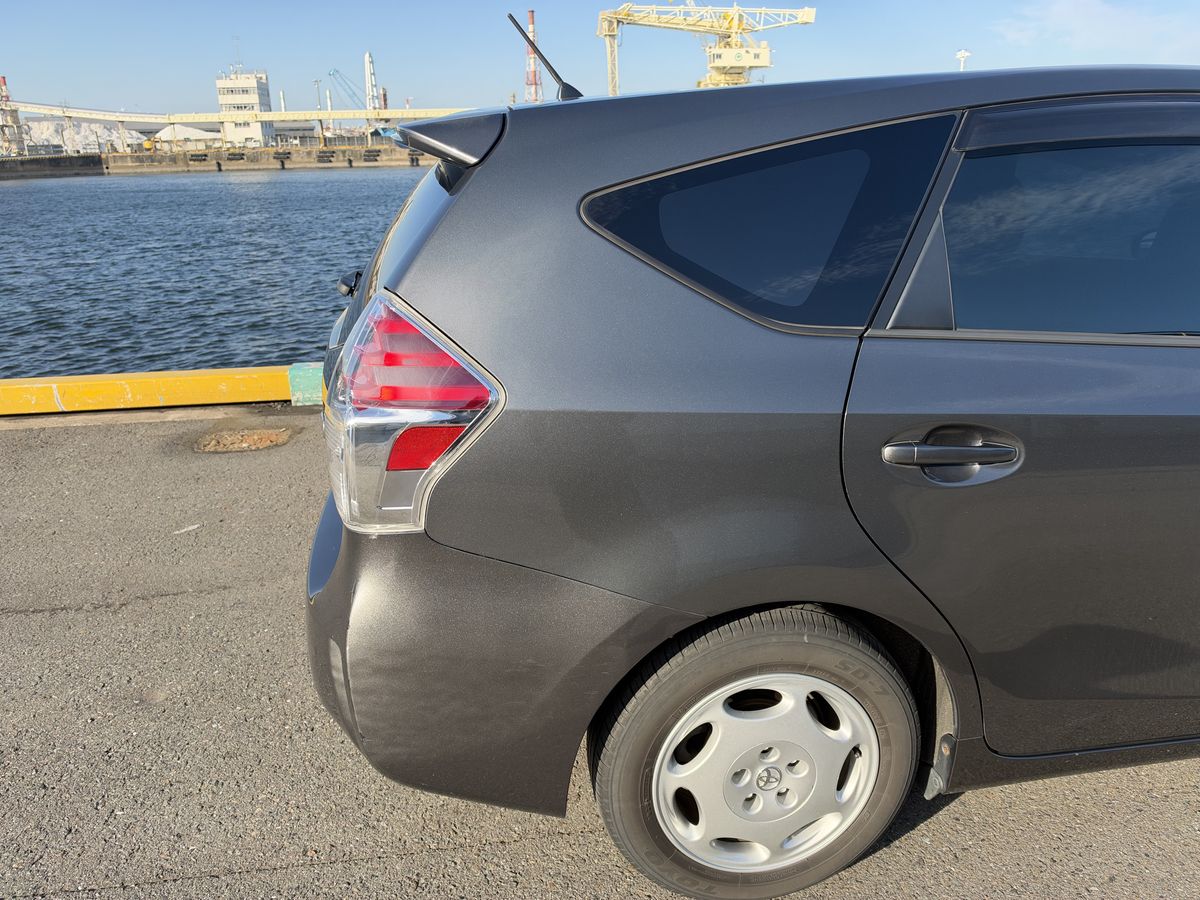
The owner says this rear bumper has been hit. It doesn't show in the photo.
What to ask for before you buy
Whether you use us or not, ask the seller for:
- Close photos of both front strut tops, taken from the engine bay with the bonnet (hood) open
- The sills and the rear wheel arches, close up, in daylight
- The underside, from ground level at each corner
- The rear of the car with the lights on, so you can see whether there's a rear fog lamp
- Confirmation that the original export certificate will be sent with the car
If the seller can't or won't take these photos, that tells you something too.
The first four stages (choosing a seller, checking the car, paying and shipping) are the same wherever you live, and they're covered in how to import a car from Japan.
Sources
All checked on 2 October 2026.
- GOV.UK, Importing vehicles into the UK: import declaration, NOVA within 14 days, VAT and duty, vehicle approval, registering, the £55 fee, the 6-week V5C, damaged vehicles
- GOV.UK, Vehicle approval: exemptions: cars over 10 years old don't need approval; Individual vehicle approval: basic IVA for personal imports, 20 working days
- GOV.UK, Vehicle registration: new registrations: form V55/5, MOT evidence for cars over 3 years old
- UK Integrated Online Tariff, commodity 8703 23 90 00: 10% third-country duty, 0% tariff preference for Japan, 20% VAT
- GOV.UK, How to value goods for import VAT: collectors' motor vehicles at least 30 years old
- DVSA, MOT inspection manual: Appendix A, structural integrity and corrosion and section 4.5, fog lamps
- European Central Bank reference rates for 1 October 2026, for the pound figures
If you'd rather know what's under the car before you pay for shipping, send us the link.