
Buying a car on Goo-net Exchange: what's checked, what isn't, and what to ask before you pay
Sources checked 2 October 2026
If you're searching "is Goo-net Exchange legit", you probably want two answers: is the company real, and is this particular car what the photos suggest. The first can be checked from public records, and we set those out below. The second is harder. On Goo-net Exchange you pay 100% in advance, sales are on a no-claim, no-return basis, and the car itself is sitting at a dealer somewhere in Japan. Photos show less than you think, so the questions you ask before you pay matter more than anything you read afterwards.
We don't rate sellers, and we don't use or work with Goo-net Exchange. Everything about the company here comes from its own pages and public listings, checked on 2 October 2026.
Who runs Goo-net Exchange
| What the public pages say | |
|---|---|
| Operator | Goonet Exchange Co., Ltd., Hamamatsu, Shizuoka |
| Parent | PROTO CORPORATION, which runs Goo-net, a large Japanese used car listing site. The subsidiary's company page shows PROTO as its 100% shareholder |
| History | Founded in 1996 under an earlier name; part of the PROTO group since 2012 |
| Secondhand dealer licence | Shizuoka Prefectural Public Safety Commission, No. 491280001821 (shown on the company's Japanese profile page) |
| Exporters' association | Listed as a member of JUMVEA (Japan Used Motor Vehicle Exporters Association), member ID 000419 |
| Office hours | Monday to Saturday, 9:00 to 18:00 Japan time |
A secondhand dealer licence is required in Japan to trade used goods, including cars, and it's issued by the prefecture's Public Safety Commission, which oversees the police. It tells you the company is registered. It doesn't tell you anything about a specific car.
How buying works
Goo-net Exchange describes four steps:
- Find a car. The listings come from dealers all over Japan that advertise on Goo-net. Goo-net Exchange mostly doesn't own the cars; it acts as the go-between, with some stock of its own.
- Send an enquiry. They reply with a quote, usually within 48 hours, including the price to the port in Japan (FOB) and sea freight. Some cars are listed as "ASK", meaning the price is given in the quote.
- Agree and pay. They issue a proforma invoice. Until your payment arrives, the car is still on sale to anyone. Payment is 100% in advance by bank transfer, card or PayPal. Once the money arrives, they buy the car from the dealer.
- Shipping. Export usually takes 2 to 4 weeks from Japan, then the sea voyage. Customs clearance and registration in your country are your responsibility, though they can introduce a clearing agent in some countries.
Two lines from their FAQ shape everything else: there is no guarantee on the condition of the car, and sales are no claim, no return. The same answer adds that the condition can be checked through a pre-export inspection and a vehicle condition certificate.
What Goo-net Exchange checks
Some cars come with a condition sheet. Goo-net Exchange says these are cars appraised by an appraiser from the Japan Automobile Appraisal Association (JAAA), which it describes as a third-party organisation.
According to its explanation page, the appraiser:
- looks over the exterior for scratches, dents, ripples and uneven colour, including the bonnet (hood)
- checks the wheels, tyre (tire) tread and the windscreen for stone chips
- checks the steering wheel, dashboard, seats and smell inside
- looks for repair marks on the pillars, the bolts in the engine bay, under the engine bay and under the boot (trunk) floor
- looks for oil leaks and listens for unusual noises
The result is a 1 to 5 star rating for the exterior and the interior, and a description for the engine and the body.
What it doesn't do
All of these come from Goo-net Exchange's own pages:
- Not every car has a condition sheet. Without one, what you have is the dealer's own photos and description.
- The condition sheet isn't a guarantee. The site says it should be independently verified.
- The engine is checked while the car is parked. There's no running check and no test drive.
- Extra photos and videos depend on the dealer. The FAQ says they're easier to get the more likely you are to buy.
- Listings can show cars that are already sold, or that can't be exported. Ask before you get attached to one.
- No returns. Anything you want to know has to be found out before the 100% payment.
None of this is unusual for buying a car from a distance. But it means the gap between the photos and the car is yours to close.
Found a car on Goo-net Exchange and want someone to look at it before you pay? Send us the link. We try to find the dealer holding the car and ask them in Japanese whether we can come and look. If they agree, we visit openly on your behalf. If we can't find the dealer, or they say no, we tell you. You still buy through Goo-net Exchange. We don't buy, sell or ship cars, and we don't take commissions from dealers or exporters.
What listing photos usually leave out
Dealer photos are taken to sell the car: the front three-quarter view, the interior, the engine bay from above. They're clean, well lit and taken from the angles that look best.
In our founder's view the exterior counts for less than most buyers think, and the underside and the strut tops count for a great deal, yet those are the parts a dealer's photos rarely set out to show (what dealer photos miss explains why).
Even on the outside, condition shows up close and side by side. These are the two headlights on our own car, photographed on the same day:

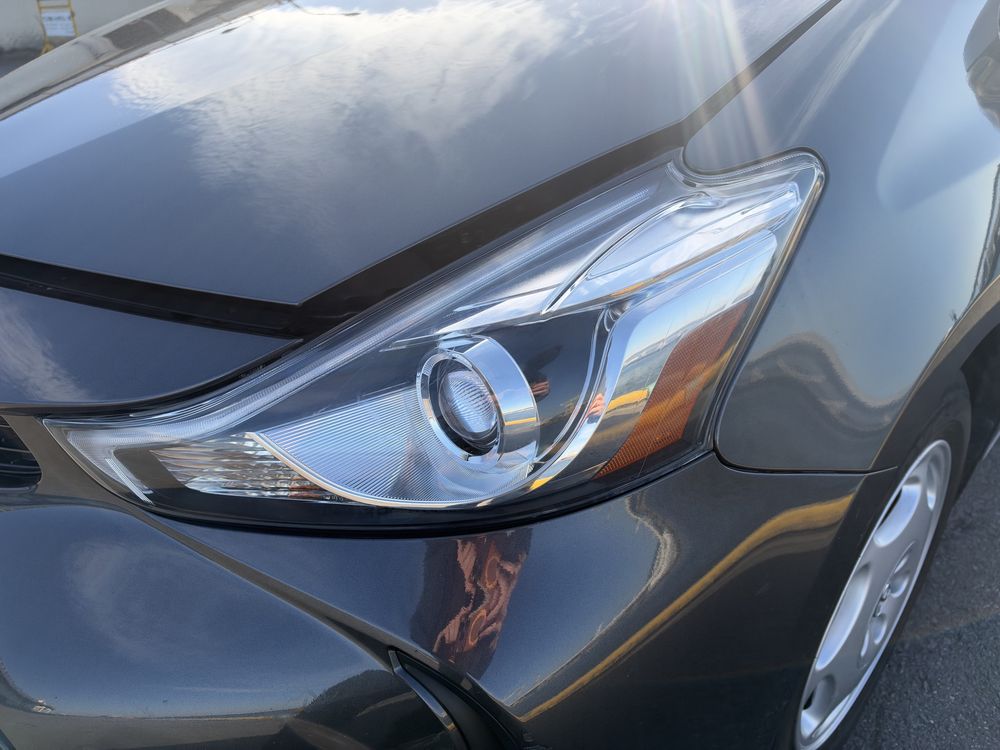
Every car is different. On one it's the rear arches, on another the sills, the floor of the boot under the mat, or one part of the interior. Whoever looks at the car for you should be looking at the spots you care about, not just the ones that photograph well.
What to check before you pay
- Ask whether this car has a condition sheet, and when it was done. If it doesn't have one, treat the listing as the dealer's description. The same goes for the repair history line: we explain what it does and doesn't cover in repair history and flood cars.
- Ask for photos of the spots that matter to you. For example: the underside as far as it can be seen, both strut tops, the rear arches and sills, and the boot floor with the mat lifted. Name the exact spots; general requests get general photos.
- Ask for a short video of the engine starting, with the exhaust in view. Ask whether the engine was already warm.
- Get the full cost in writing. The quote, the "ASK" price if there is one, freight, marine insurance and any pre-export inspection your country requires, and your clearing agent's charges and import taxes at home.
- Check your own country's import rules with your own government. Goo-net Exchange's FAQ gives a short summary for several countries, but the rules are set and changed by your government, not by the seller.
- Pay only to the bank account on the proforma invoice. Goo-net Exchange itself says this is its only account in Japan for payment and asks buyers not to send money anywhere else.
- Remember the car stays on sale until your money arrives. If you need more time for questions, say so before you pay, not after.
If the answers come back incomplete, that's useful information too. A photo you asked for that never arrives tells you where to look hardest.
If the car is somewhere we can reach
We're based in Kuwana, Mie Prefecture, and mainly cover Aichi, Gifu and Mie. For a car there, we can go to the dealer, look at the car in person and send you photos, video and a plain-English report that separates what we saw, what the dealer told us, and what we couldn't check. See how a viewing works.
For a car anywhere else in Japan, a Remote Check is a phone call to the dealer in Japanese: your questions, the extra photos you're missing, and a translation of the paperwork. It ends with a list of what photos and phone calls can't show for that car.
We don't tell you whether to buy. That's your call, and you'll make it better with more of the car in front of you.
Sources
- Goo-net Exchange, About Us, checked 2 October 2026
- Goo-net Exchange, FAQ, checked 2 October 2026
- Goo-net Exchange, How to Buy, checked 2 October 2026
- Goo-net Exchange, What is Condition Sheet?, checked 2 October 2026
- Goonet Exchange Co., Ltd., company information (Japanese), checked 2 October 2026
- JUMVEA, member page for Goonet Exchange Company Limited, checked 2 October 2026
If you've narrowed it down to one car, the next step is simple: send us the link and tell us which spots worry you.